

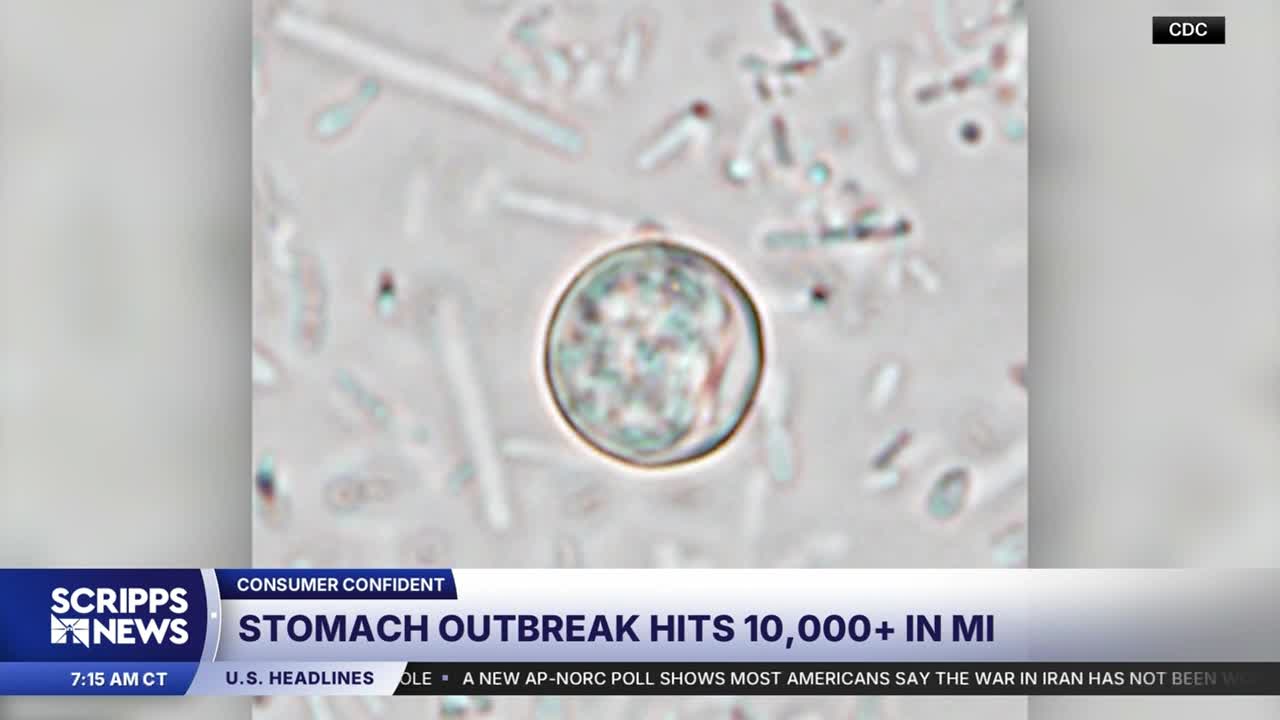


About 1 in every 1,000 people in Michigan has had cyclosporiasis over the past three months amid a multistate outbreak that has grown to the largest on record.
More than 10,000 cases have been reported in Michigan during the outbreak investigation period, according to the state health department. The state is home to about 10.1 million people.
Cyclosporiasis is caused by a microscopic parasite that can contaminate fresh food or water and lead to severe diarrhea in those infected.
Iceberg lettuce supplied by Taylor Farms has been recalled, and it’s likely that contaminated products have already been eaten or removed from shelves.
“We do have the outbreak under control,” US Health and Human Services Secretary Robert F. Kennedy Jr. said last week, noting the recall.
But illness can take a while to appear, and thousands of new cases were reported nationwide over the past week.
Health officials are racing to trace the details of cases in an ongoing investigation, but the parasite is notoriously difficult to find. Testing produce can be challenging, and people who are sick may be asked to remember what they ate weeks earlier to help identify a common thread.
Cases of cyclosporiasis are known to rise during spring and summer months in the US, with a typical season running from the start of May through the end of August, according to the US Centers for Disease Control and Prevention. But case counts are particularly high this year.
Here’s what we know about the situation so far.
How big is the outbreak?
The CDC has identified more than 18,000 cases of domestic cyclosporiasis this season; 6,707 cases are confirmed, and about 11,500 others are undergoing further laboratory testing and analysis to determine whether the illness was acquired in the US.
Multiple clusters of cyclosporiasis cases are being investigated this year by the US Food and Drug Administration in collaboration with the CDC and state partners, including the particularly large multistate outbreak centered in the Midwest.
The CDC has linked 1,947 cases to this specific outbreak as of last week.
However, CDC data includes only confirmed cases, and data from individual states shows much higher case counts.
What states are part of the outbreak?
The CDC has identified nine states with cases linked to the ongoing outbreak: Illinois, Indiana, Kansas, Kentucky, Michigan, Ohio, Oklahoma, Pennsylvania and West Virginia.
Michigan has reported more cyclosporiasis cases than any other state – there have been at least 10,077 cases since May 1, according to the Michigan Department of Health and Human Services. The state health department has said that it “cannot say with certainty that every illness is linked to the same source of exposure” but that the concentrated, sharp increase in cases “strongly suggests that the vast majority of these illnesses are associated with the same outbreak.”
As of Wednesday, the eight other states linked to the outbreak have reported more than 5,000 cases in total: Ohio has reported at least 2,574 cases, Indiana has reported 1,092 cases, Illinois has reported 532 cases, Kentucky has reported 468 cases, Kansas has reported 461 cases, Oklahoma has reported 303 cases, West Virginia has reported 245 cases, and Pennsylvania has reported 82 cases.
Some states update case counts daily, while others update weekly or a few times each week.
“The true number of sick people in this multistate outbreak is likely higher than the number reported, and the outbreak may not be limited to the states with known illnesses,” according to an update from the CDC.
Overall, 45 states have reported at least one domestically acquired cyclosporiasis case this season, according to the CDC.
However, some states — including California and New Jersey — have noted that the number of cases they have reported this year is in line with typical seasonal trends.
RELATED STORY | CDC links Taco Bell lettuce supplier to massive cyclospora outbreak
What foods are affected in the large outbreak?
Everyone wants to know if their meals are safe. Is cilantro safe to eat? Are tomatoes safe to eat? Is romaine lettuce safe to eat?
Health officials in Michigan said they’ve completed more than 2,000 interviews of people sick with cyclosporiasis. They said there’s “very strong” evidence linking the outbreak to one product in particular: Shredded iceberg lettuce supplied by Taylor Farms is the likely source. That contaminated lettuce was served at some Taco Bell locations.
CDC recommends that people not eat any shredded iceberg lettuce from Taylor Farms de Mexico served at Taco Bell locations in states with cases linked to the outbreak: Indiana, Kentucky, Michigan, Ohio and West Virginia.
The FDA is working to determine whether contaminated shredded iceberg lettuce went to other places.
Taco Bell said that it has removed Taylor Farms lettuce from its restaurants and its nationwide supply chain, and supplier Taylor Fresh Foods said that it’s removing all of its iceberg lettuce from central Mexico from the US market.
In a LinkedIn post last week, Taco Bell CEO Sean Tresvant thanked Taco Bell “fans” for their support and promised to take steps to build a stronger food system.
“We aren’t entitled to your loyalty. We earn it one meal at a time,” he said. “There is a better way forward, and we are going to lead the way.”
Taylor Farms has also recalled iceberg lettuce shipped to 27 states. Some of it went to Walmart and Jack in the Box. Other shipments went to food services.
The investigation is ongoing, but no other foods have been identified to be part of this outbreak. Other foods most commonly linked to cyclospora outbreaks historically include basil, cilantro, berries and snap peas.
Federal health officials said there have been multiple investigations around cyclospora this year, some tied to the large outbreak in the Midwest, some involving single states and some involving cases not yet tied to any cluster.
How long does it take to get sick?
Illnesses associated with the current outbreak started in mid-May, and new illnesses have started as recently as last week, according to the CDC.
It can take days – or up to two weeks – for symptoms of cyclosporiasis to appear after consuming contaminated food or water.
Symptoms include watery diarrhea, loss of appetite, weight loss, cramping, bloating and increased gas, nausea and fatigue.
People who become ill may have symptoms for weeks.
How severe is it?
At least 98 people have been hospitalized in relation to the current outbreak, according to the CDC. Hundreds of other cyclospora hospitalizations have been reported this year.
States specifically linked to the outbreak have reported dozens of cyclospora hospitalizations. There have been at least 160 hospitalizations in Michigan and at least 134 hospitalizations in Ohio, among others.
No deaths have been reported.
How does this compare to other outbreaks?
According to a 2023 report from the US Department of Agriculture’s Food Safety Inspection Service, the largest cyclospora outbreak in the US on record led to about 1,500 cases and involved raspberries. Other large outbreaks typically haven’t surpassed 1,000 cases.
With nearly 2,000 cases linked to the current outbreak centered in the Midwest, it is the largest known cyclospora outbreak in the US to date.
The total number of cyclosporiasis cases reported this year in the US is also higher than usual.
There were more than 4,500 cases in 2023 and more than 3,500 cases in 2024, according to federal officials. But there have already been more than twice as many reported this year, with at least a month left in the season.
What else could be causing stomach issues?
French biotech company bioMérieux tracks trends in gastrointestinal pathogens by collecting test results from a network of laboratories.
Its data shows that the prevalence cyclospora and other parasites has surged in the US over the past month, rising from less than 3% of tests in the second week of June to more than 15% in mid-July.
But E. coli is still a more common culprit for stomach issues in the US right now. The surveillance data shows that the bacteria was present in more than 19% of tests.
Viruses can also cause gastrointestinal problems, and more than 14% of tests in the US tested positive for these pathogens between July 26 and July 29.
The-CNN-Wire
™ & © 2026 Cable News Network, Inc., a Warner Bros. Discovery Company. All rights reserved.
