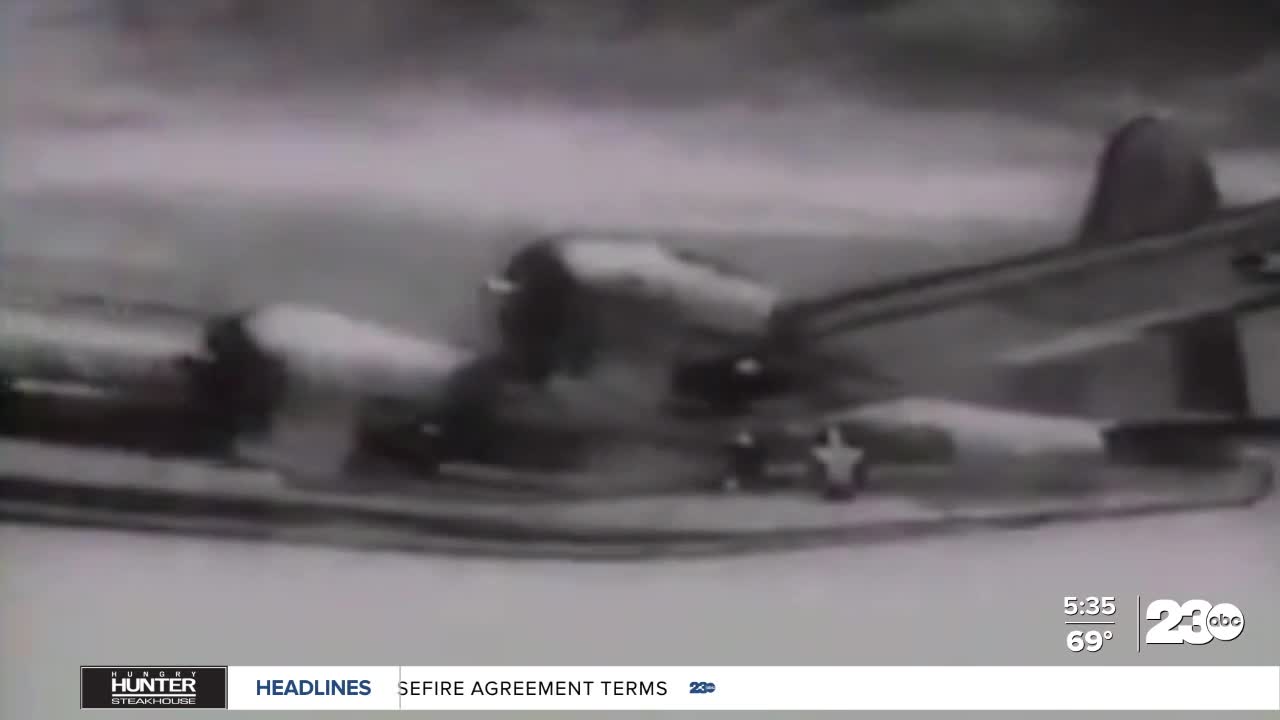


BAKERSFIELD, Calif. (KERO) — Everett Williams was drafted into the U.S. Army Air Corps in 1942 and trained as a gunner — first on the B-17 Flying Fortress, then on the new B-29 Superfortress. He expected to be sent to England. Instead, he was sent to the Pacific.
Stationed on the island of Guam, Williams flew 27 combat missions over Japan — more than required — including the first daylight raid over Tokyo, for which he was awarded the Distinguished Flying Cross. Each mission meant 7 hours to the target and 7 hours back, 14 hours in the air, tucked into a small blister on the right side of the aircraft.
"All my combat missions were against Japan and from Guam, where I was stationed. Iwo Jima was 700 miles away. Then it was 700 more miles up to Japan. And I flew 27 missions against Japan, which was more than what you need to be," Williams said.
Williams served as a blister gunner — a position on the side of the B-29 fuselage that gave him a wide field of view and control over multiple gun turrets. The 13-man crew of a B-29 was not just airmen — every one of them was also a trained mechanic.
"It took 13 men to command a B-29. It took the whole crew. And every one of them was a highly trained mechanic," Williams said.
On his very first mission, Williams' crew targeted a Japanese fuel refinery between two of Japan's main islands. They destroyed it — but came home with 2 engines shot out. The crew landed at Iwo Jima and repaired the aircraft themselves before returning to Guam.
The B-29 was the only American bomber with the range to make the round trip from Guam to Japan and back. A B-17 couldn't make it. Neither could a B-24. Flying at high altitude to conserve fuel, the crews ran their engines at 2,100 RPM and 31 inches of manifold pressure — a setting Williams still remembers decades later — cruising at about 237 miles an hour.
The Japanese fired 140-millimeter anti-aircraft guns at the B-29s — larger than the 88-millimeter guns used by the Germans in Europe. But Williams said the Japanese were far less accurate than the Germans, in part because American forces had broken the Japanese code and knew their movements in advance.
"They didn't know that we had broken their code and knew what they were gonna do, and they didn't know that we knew," Williams said.
P-51 Mustang fighters based on Iwo Jima provided escort for the B-29s on their runs to Japan. Williams recalled that the P-51 cockpit was so cramped that pilots couldn't even tip up a canteen to get a drink during the long missions.
When Japanese kamikaze pilots launched suicide missions, Williams' crew used a calculated strategy — bombing the fuel supplies at Japanese air bases just after the kamikazes took off. When the suicide planes returned, they had nowhere to land and no fuel to find another target.
By the time Williams flew his 27th and final combat mission, American bombing had devastated Japan's industrial base. Factories, steel mills, and supply lines had been destroyed. U.S. submarines had cut off Japan's access to raw materials so severely that the Japanese were reportedly building aircraft from aluminum cookware pulled from civilian kitchens.
Williams' last mission was not a bombing run. After Japan's surrender, his crew loaded 10 tons of supplies into their bomb bay and flew to a prisoner of war camp in a town called Tau to deliver medicine, clothing, and blankets to American POWs. To make sure the supplies reached the prisoners and not Japanese civilians, the captain made a decision — fly in at 20 feet above the ground and knock down the camp's chain-link fence with the force of the drop.
The mission succeeded. The POWs got the supplies. But Williams learned years later that the low-altitude drop caused some parachutes to fail to open. One of the supply boxes killed a prisoner — a man who had survived the Bataan Death March, only to die in the final days of the war.
"We came in probably 20 ft above the ground and salvaged the load, and it knocked the fence down until the POWs got what we were dumping. I mean, we were really proud of that," Williams said.
Williams was discharged on December 7, 1945 — exactly 4 years after the attack on Pearl Harbor. He returned to Ventura County, where he grew up in Oakview, attended high school in Ventura, and worked in the oil fields.
This story was reported on air by a journalist and has been converted for this platform with the assistance of AI. Our editorial team verifies all reporting on all platforms for fairness and accuracy.
Stay in Touch with Us Anytime, Anywhere: