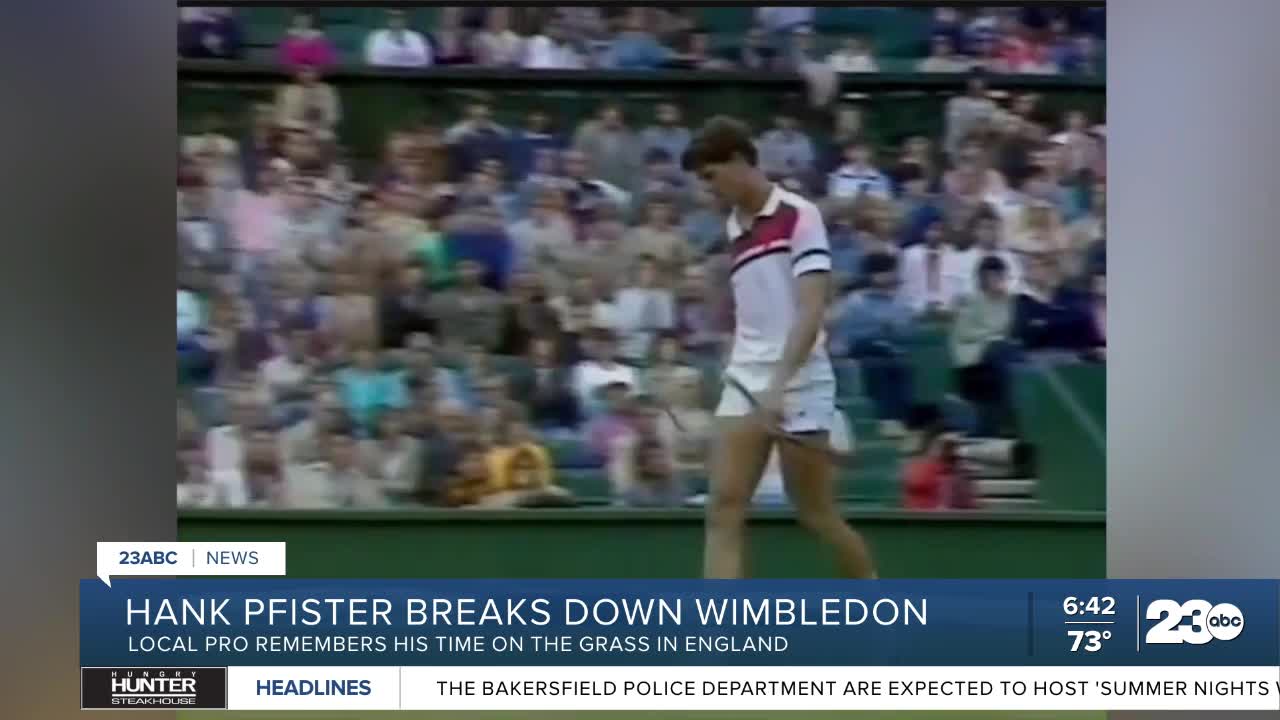


BAKERSFIELD, Calif. (KERO) — Wimbledon's singles finals are set for this weekend, and Bakersfield tennis legend Hank Pfister sat down to reflect on his time competing on the sport's most storied grass courts — and what he sees in the game today.
Pfister reached a career-high world No. 19 ranking in men's tennis and competed in all four Grand Slam events sporadically from the late 1970s through the mid-1980s, including multiple appearances at Wimbledon.
Pfister is not the only Bakersfield player to leave a mark at Wimbledon. Dennis Ralston, the most accomplished tennis player to come out of Bakersfield, won a doubles title at Wimbledon in 1960 at age 17 — the youngest player to win at the tournament at that time. Ralston reached the men's singles final at Wimbledon in 1966 and won several Grand Slam doubles titles throughout his career. He also led multiple U.S. Davis Cup teams to victory.
And they weren't the only players from Bakersfield to make it to the All England Club. At one point, a half dozen players from the city were in the Wimbledon draw at the same time — all from the Bakersfield Racquet Club.
"There were six players from Bakersfield in Wimbledon at the same time," Pfister said.
Those players included Marianne Werdel, Camille Benjamin, Bill Maze, and Brad Rowe. While Pfister held the highest ranking of the group in the modern era of ranking systems, Werdel and Benjamin were both ranked in the top 50 in the world at the time.
"If that happened today, people would go, 'What's in the water? What are they doing?' But no, they'd be flocking here trying to figure out what the recipe was," Pfister said.
Pfister described the experience of walking onto the Wimbledon grounds for the first time as overwhelming.
"The first time you just walk onto the grounds, and you see the center court with the ivy hanging on it, you're just about to wet your pants. I mean, it's pretty amazing. And then when you have your first center court match, and you walk out, and you end up bowing to royalty and turning around and playing — all of a sudden you're on center court Wimbledon," Pfister said.
"It's something that you just can't explain. It's overwhelming," Pfister said.
Pfister played a serve-and-volley style during his career, a style he says has largely faded from the modern game — something he finds disappointing.
"I enjoy watching matches where people are doing something different. Like Alcaraz, he'll hit some drop shots, and he'll serve and volley, he'll crack returns and run to the net. But to watch a match where a guy just hits a big serve and sits back there and pounds forehands — I can watch that for a certain amount of time, and then I go, 'I got other things I want to do,'" Pfister said.
On the current state of American tennis, Pfister said the numbers surprised even him heading into the conversation.
"I knew I was gonna talk to you, and I thought I better figure out — there's 14 Americans in the top 100 in the guys. And there are 12 or 13 girls in the top 100. That surprised me. I didn't know that number was that big," Pfister said.
"15 years ago, people were going, 'What's wrong with American tennis? We don't have any top players.' But now they're everywhere," Pfister said.
Pfister weighed in on Taylor Fritz, who was eliminated in the Wimbledon quarterfinals. He said a knee issue appeared to affect Fritz's movement and ultimately his performance.
"He was having a little knee issue. I could tell that he just wasn't getting out of the hole quickly. He moved OK, but when you're a little restricted on your movement, you have to hit a little bigger and go for a little bit more, and he made a few more errors than he needed to," Pfister said.
"He'd beaten Alexander Zverev 6 or 7 times in a row, so he owned this guy. It was frustrating, I'm sure, for him not to be able to move the way he needed to move on the court — that had to be frustrating," Pfister said.
On the women's side, Pfister said Coco Gauff stands out as the player with the brightest future, even after her Wimbledon exit.
"Right now she is [the one to beat]. Jessica Pegula's tough. We have a couple of top players. But Coco seems to be in the semis at all the Grand Slams. She's getting there all the time," Pfister said.
Gauff's run ended in an 11-9 third-set tiebreaker.
"You don't get any closer than that," Pfister said.
Looking at the sport's overall evolution, Pfister said there is no question the game has advanced.
"Absolutely, it's advanced. Every sport has advanced. The serves — guys are serving harder, faster. They're bigger, stronger. It's like looking at any sport, swimming or track. You look at the times, and you go, 'Wow, 10 years ago I wouldn't even qualify for the Olympic trial team,' Pfister said.
Pfister currently volunteers as a coach with the Bakersfield College tennis team. He said he still gets on the court with players — on his own terms.
"I've been helping the BC team as a volunteer coach, and it's fun. I have a good time doing it," Pfister said.
"I hit with them a little bit, but they have to hit the ball directly to me. I said I'm not running. If you wanna hit right here — no more serve and volley those days. Just hit groundstrokes directly to me, and we can have a conversation," Pfister said.
This story was reported on-air by a journalist and has been converted to this platform with the assistance of AI. Our editorial team verifies all reporting on all platforms for fairness and accuracy.
Stay in Touch with Us Anytime, Anywhere: