

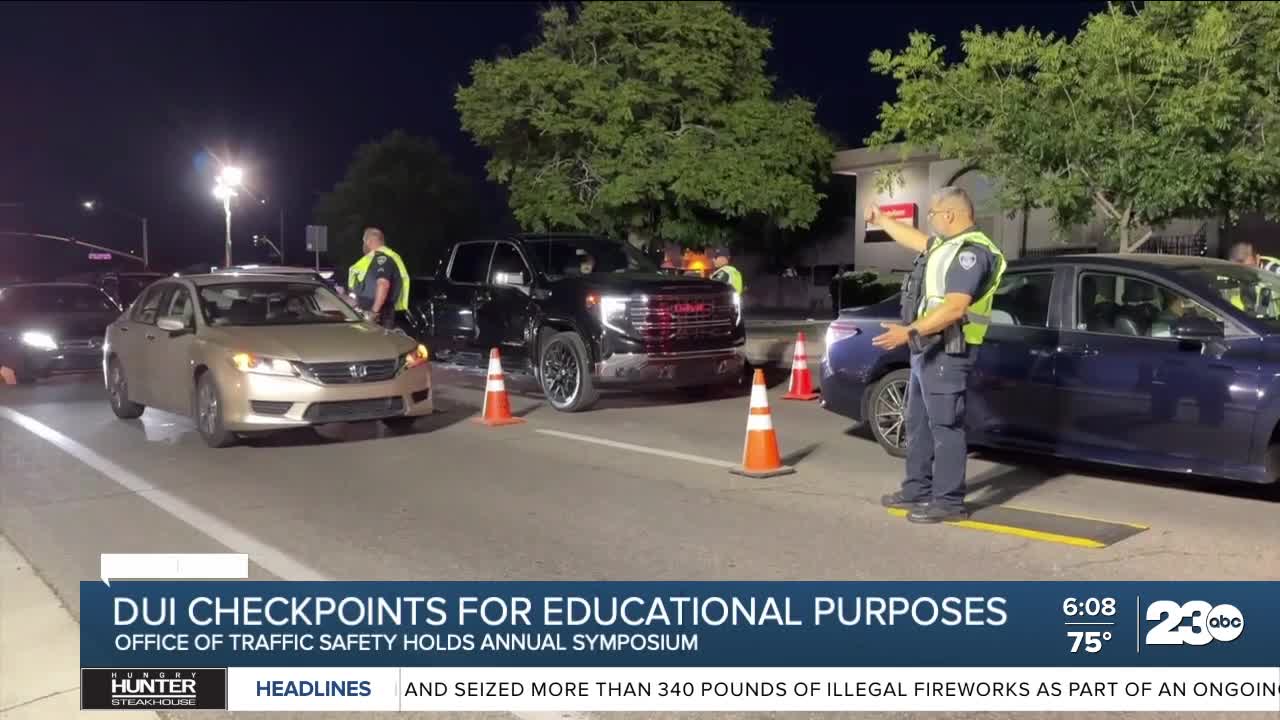

BAKERSFIELD, Calif. (KERO) — Most people assume DUI checkpoints exist to catch impaired drivers. According to a Bakersfield police lieutenant, that has never been the primary goal.
Lt. Mitch Galland of the Bakersfield Police Department's traffic division said the core function of DUI checkpoints has always been education and deterrence — a point reinforced at a recent annual symposium hosted by the Office of Traffic Safety.
"It's a high-profile deterrent event, right? Reminds everybody that we're out here, that we're looking for certain things," Galland said. "It's educational, trying to explain to people the problems with their, you know, with drinking and driving, but other things as well. And then, yeah, if we find DUI drivers or we find drivers without licenses or with felony warrants, then by all means we'll take action, but that's really not our primary focus."
The legal foundation for DUI checkpoints comes from a case known as Ingersoll, which established that checkpoints represent a limited intrusion and therefore do not violate civil rights. Galland said that framing is central to how the National Highway Traffic Safety Administration views them as well.
Checkpoints also serve a deterrent function for drivers who might otherwise choose to drink and drive, Galland said.
"If you've been through one, you realize like, oh, this could pop up anywhere, any day," Galland said.
While checkpoints are typically held on weekends, Galland said OTS can approve weekday operations if local collision data supports the need — and he said BPD already has that data on hand.
BPD also conducts DUI saturation patrols, which are separate operations where officers actively look for impaired drivers rather than screen vehicles at a fixed location. Galland said the two approaches serve different purposes and are sometimes combined into a single operation.
The department deployed 4 extra patrol cars for a standalone saturation patrol 3 to 4 weeks ago. BPD also recently partnered with CHP on a joint saturation patrol that brought in high-performing officers from Modesto and Fresno.
"The more the merrier, we'll take any help we can get," Galland said.
Galland noted that checkpoints occasionally turn up drivers with outstanding felony warrants — even though warning signs allow drivers to avoid the checkpoint entirely.
"If you knew you had a felony warrant, you'd think like, oh, there's a DUI checkpoint ahead, and I don't have a driver's license, I'm just gonna go ahead and turn right," Galland said. "And they drive in. I don't know what they think."
The OTS holds one major symposium per year and a smaller secondary event, alternating between Northern and Southern California.
Results from DUI checkpoint, June 12, 2026:
1,318 vehicles screened. Seven (7) drivers were detained for further evaluation to determine their sobriety level. Three (3) drivers were subsequently arrested for DUI. During the checkpoint, six (6) drivers were cited for driving on a suspended license, and twenty-two (22) were cited for driving unlicensed. Fifteen (15) vehicles were impounded.
This story was reported on-air by a journalist and has been converted to this platform with the assistance of AI. Our editorial team verifies all reporting on all platforms for fairness and accuracy
Stay in Touch with Us Anytime, Anywhere:
