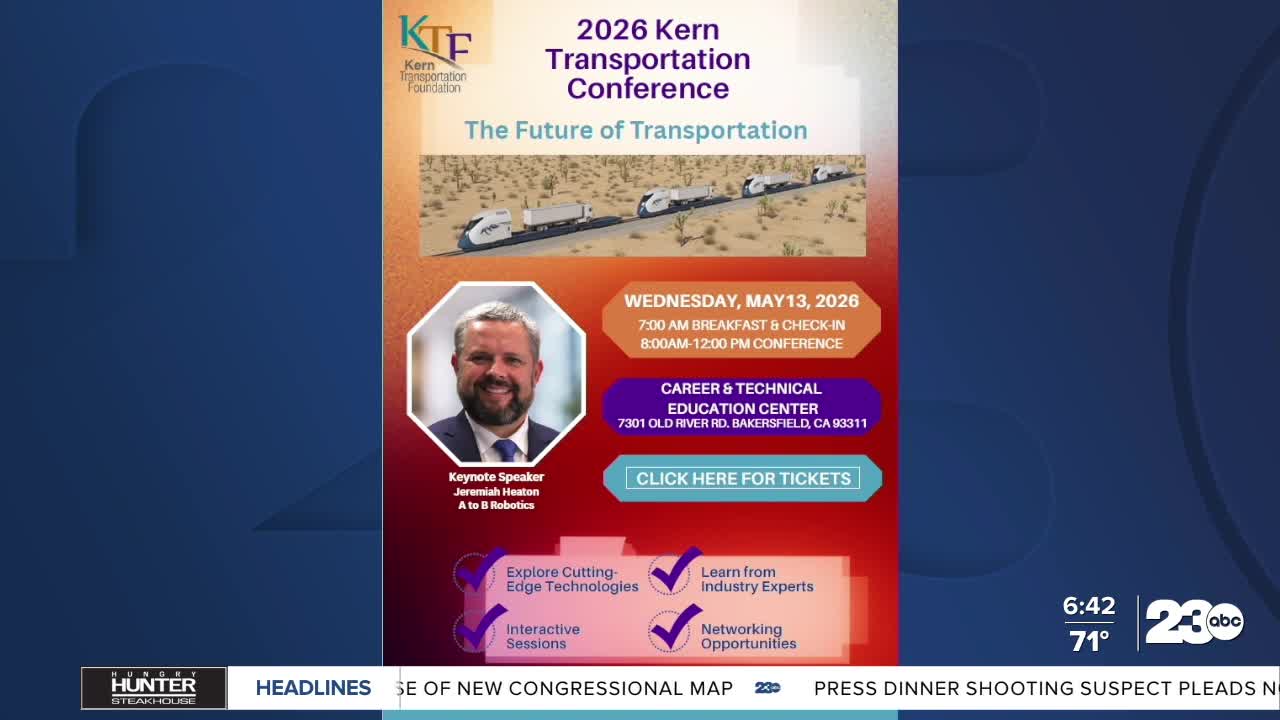

BAKERSFIELD, Calif. (KERO) — The Kern Transportation Foundation is hosting its 34th annual conference on Wednesday at C-TEC in Southwest Bakersfield, bringing together transportation experts to discuss the future of freight movement — including a keynote presentation on autonomous rail technology.
Jeremiah Heaton of A and B Robotics is the keynote speaker. Heaton is proposing a self-moving flatcar capable of carrying containers or trailers independently on rail lines without traditional locomotive power.
Ron Wareham, vice chair of the Kern Transportation Foundation, said the concept is unlike anything the conference has featured before.
"We have a gentleman who is proposing something that's very, very new in transportation, a self-moving flat car that can put containers or trailers on a flat car. The flat car itself is an independent moving vehicle."
Wareham, who began his career with the Santa Fe Railway — which later became BNSF — has spent nearly 60 years studying transportation, with a focus on rail. He said that while the idea of autonomous rail is exciting, significant obstacles stand in the way.
"Having the trackage, the mainline railroads are very protective of their mainline rail, and rightfully so. That's why we don't have a coast-to-coast Amtrak or passenger rail anymore because hauling freight has become, you know."
Wareham pointed to highway congestion as a driving force behind renewed interest in rail freight, but said the existing rail network presents challenges for any autonomous system.
"Our highways are just tied up with truck traffic, and trying to move things through the railroad. They have to have that command of that railroad, and they have the dispatching done from, you know, thousands of miles away, and uh, having an autonomous railroad is. I mean, I'd love to see it, but I don't think it'll happen right away. It's gonna take time."
He said building an entirely independent railroad to support autonomous flatcar technology would require enormous investment.
"How do we keep moving freight with the major railroads, and they control it? How are you building an independent railroad? It would be a huge, huge, huge thing to do. Could we do that? It'd take a lot of time and a lot of money."
Wareham cited the Tehachapi Loop in the San Joaquin Valley as an example of just how long major rail infrastructure projects can take, calling it the 8th wonder of the world. He said it took 12 years to prepare the loop to haul containers and trailers out of the valley.
Looking back over the conference's 34-year history, Wareham said the single biggest development in transportation has been the rise of trailer-on-flatcar and container-on-flatcar rail service, which shifted significant freight volume off highways and onto rail lines.
As for whether autonomous rail could eventually be incorporated into California's high-speed rail project, Wareham said he was uncertain.
"Not that I know of, but maybe, maybe this gentleman has something that I don't know."
Seats are still available for the conference. Registration is available at kerntransportation.org.
This story was reported on-air by a journalist and has been converted to this platform with the assistance of AI. Our editorial team verifies all reporting on all platforms for fairness and accuracy.
Stay in Touch with Us Anytime, Anywhere: