

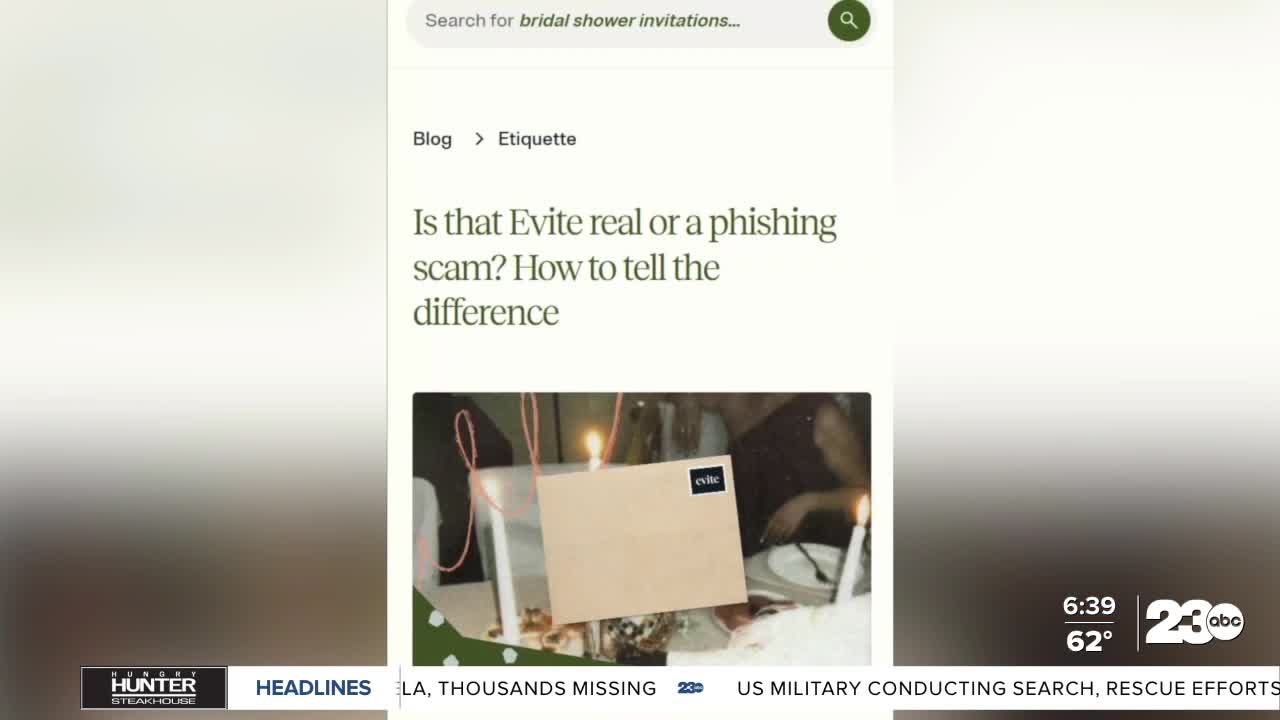


BAKERSFIELD, Calif. (KERO) — Get a party invite in your inbox? Make sure it’s real!!
Are you invited to a party? What do you wear? What do you bring? How do you know it’s not a scam?
Major email invitation businesses like Evite https://www.evite.com/blog/etiquette/how-to-spot-phishing-email-scam, Punchbowl https://help.punchbowl.com/article/808-how-do-i-know-if-the-punchbowl-invitation-or-card-i-received-is-real-or-spa,m and Paperless Post https://www.paperlesspost.com/blog/how-to-spot-phishing-scams/?srsltid=AfmBOoqqKGbkaqNNKK02cRBk3DpM60VwFF_BwVk2i1yKq708t94pt0IH are warning about recent increases in these scams. The fakes look much like real invites. The goal is for scammers to get you to log in or click a link. It may allow them to install monitoring tools or get your passwords and access your accounts. Is your invite a scam? If you’re a guest required to log in, don’t!Only hosts have to do that. Make sure the email sender address ends in the legit invite company name, like evite.com or paperlesspost.com, not Yahoo, Gmail, or anything else. Hover over links and check the bottom of your screen to see if the real destination matches. If you did enter information on one of these sites and think it was a scam, change your email password and warn contacts. More scam warnings at joeknowsbetter.com. Better Business Bureau has more advice on how to spot email phishing scams:
Recognize common tactics. Phishing emails generally use the same tactics over and over to trick victims. Scare tactics and emails that produce a sense of urgency are quite common in phishing scams, as are promises of rewards that sound too good to be true. For example, if an email says there is a problem with your credit card or your account is about to be deleted if you don’t click a link immediately, it’s probably a phishing threat. If you get an email asking you to click a link or log into an account to get a surprisingly good prize, offer, or even a government grant, think twice.
● An email may come to you in the name of a reputable compan,y but look closely at the sender’s email address. If the address is unrecognizable, perhaps a long string of letters and numbers that don’t make sense, it’s probably an impostor. Don’t be too quick to trust email addresses with company names in them either. An email may come to you from an address that ends in @my.netflix.work, which is a far cry from an official email ending like @netflix.com.
● Double-check hyperlinks before you click on them. Roll over any links in an email you receive before you click to see where the link really leads. Suspicious links are one of the main giveaways of email scams. Sometimes, links are shortened with bit.ly or a similar service, so you can’t tell exactly where they are at first glance. Other times, when you roll over what looks like a real link, you’ll find the address doesn’t correspond with what’s stated in the blue link text. Another red flag is if the link looks familiar but contains slight misspellings. Always check that a link is legitimate before you click on it; it could lead you to a dangerous website or download malware onto your computer.
● Don’t be quick to confirm personal information. Most scam emails are designed to look just like emails you receive from a business you trust, but with unusual requests. For example, if your bank suddenly sends you an email asking to confirm personal information, such as your account number and address, don’t reply and delete the message. If any company sends you an email asking you to provide your login credentials via email, this is a big red flag. If you think that an email could be legitimate, it’s always a good idea to contact the company directly – not via any link or contact information in the email – to inquire.
● Be alert to poorly written emails. Many scam emails are full of grammatical errors, poor spelling, and strange-sounding phrases. Remember that legitimate companies have their email messages written by professionals, edited and revised so they never come across as unprofessional. If you get a poorly written email from a reputable business, it’s probably a phishing scam.
● Be wary of attachments, even if they are sent by a friend. If you receive an email with an unexpected attachment, don’t be too quick to open it. If you click on a malicious attachment, it could download a virus or malware onto your PC or network. Even if it looks like you know the person or company who sent the message, check with them first to make sure the attachment is safe.
● Keep your security software up to date and running. The FTC recommends protecting your computer and mobile devices with security software that can help you recognize threats before it’s too late. Keep any software you install up to date so it can protect you against new threats. In addition, if you think you clicked on a dangerous link by accident, you can open up your security software and run a scan right away to identify and potentially contain the threat.
Report any scams you encounter to BBB.org/ScamTracker. When hiring, check for trusted Accredited Businesses at bbb.org
