

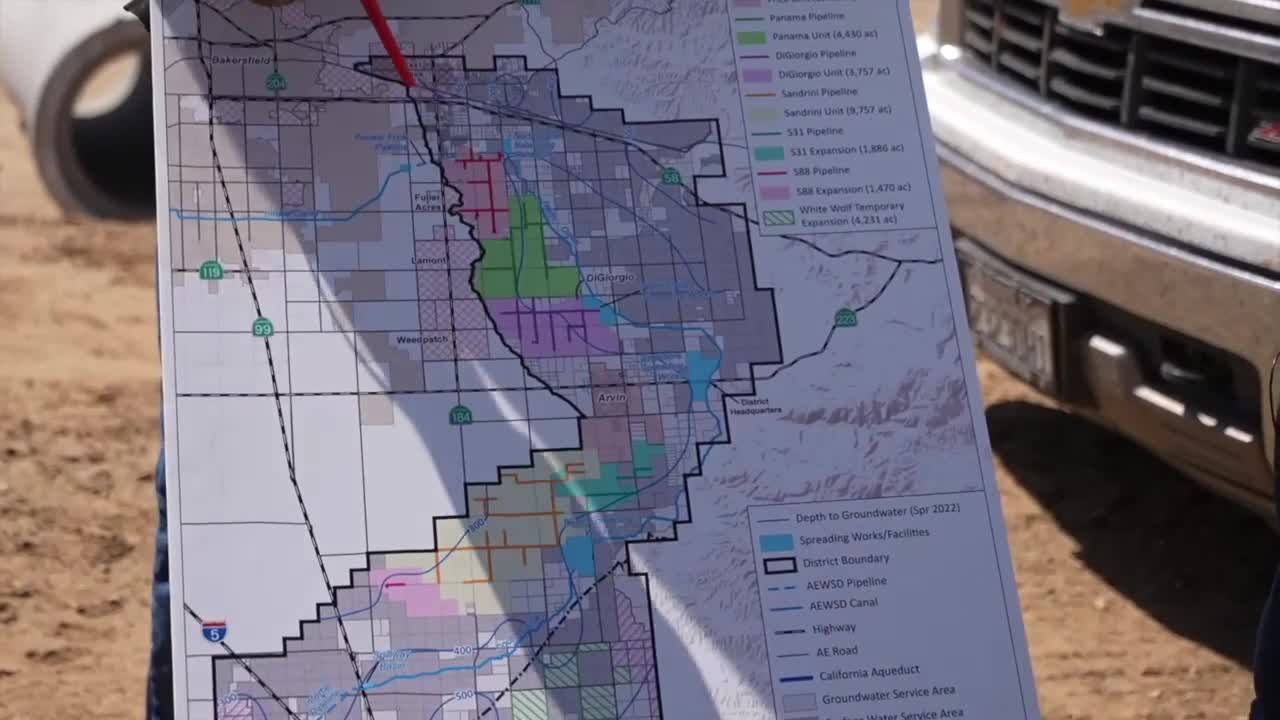


ARVIN, Calif. (KERO) — Efforts to strengthen water storage and delivery systems in California’s Central Valley are gaining momentum, as federal and local leaders emphasize the need for groundwater recharge projects and long-overdue infrastructure upgrades.
For communities like Arvin and Lamont, water largely comes from underground sources, making stable groundwater levels essential.
“It makes the water levels sustainable so that groundwater pumping doesn’t become so expensive for water districts,” said Raul Barraza Jr., general manager of the Arvin Community Services District.
Barraza said when groundwater levels decline, the cost to pump water increases — costs that are often passed on to residents.
To address that, the Arvin Community Services District is partnering with the Arvin-Edison Water Storage District on a $2 million project to expand groundwater recharge capacity. The project is funded through federal dollars secured by Rep. David Valadao and is one of several water infrastructure efforts across the 22nd Congressional District.
“All of the communities that you see around these areas are going to be direct beneficiaries,” Barraza said.
The project will convert about 160 acres of farmland into groundwater recharge basins, allowing excess water during wet years to be stored underground for future use.
“The water will go underground, it stays there until we need it,” Valadao said.
Arvin-Edison Water Storage District Manager Jeevan Muhar said the stored water will help supply both farmers and communities during dry years. He added that once recharge projects are completed, the district will shift focus to expanding pipeline systems.
“We’rewfocusing on recharge projects, which we've got others that we recently completed. And then mostly after that, we're doing pipelines.” Muhar said. “And so in a wet year in a wet period, if we can get folks that are on groundwater for most of the part because they can't have access to our facilities, we've got these general areas where we're looking to move surface water and turn off groundwater.”
Valadao said the investment is critical not only for maintaining water supply but also for ensuring the region’s long-term stability.
Officials say adding cleaner surface water into underground systems can also help reduce contamination risks and maintain the quality of existing wells — an ongoing concern in some Central Valley communities.
The approach may also help avoid costly infrastructure upgrades.
“If you drill a new domestic well right now, you’re probably paying $3.5 million when it’s all said and done,” Barraza said.
Once pipeline construction is complete, Muhar said the system will be able to deliver surface water to about 4,000 acres within the district during wetter periods, reducing reliance on groundwater pumping.
Local leaders say the combined efforts are aimed at creating a more reliable, affordable and sustainable water system for both residents and agriculture in the region.
Stay in Touch with Us Anytime, Anywhere:
