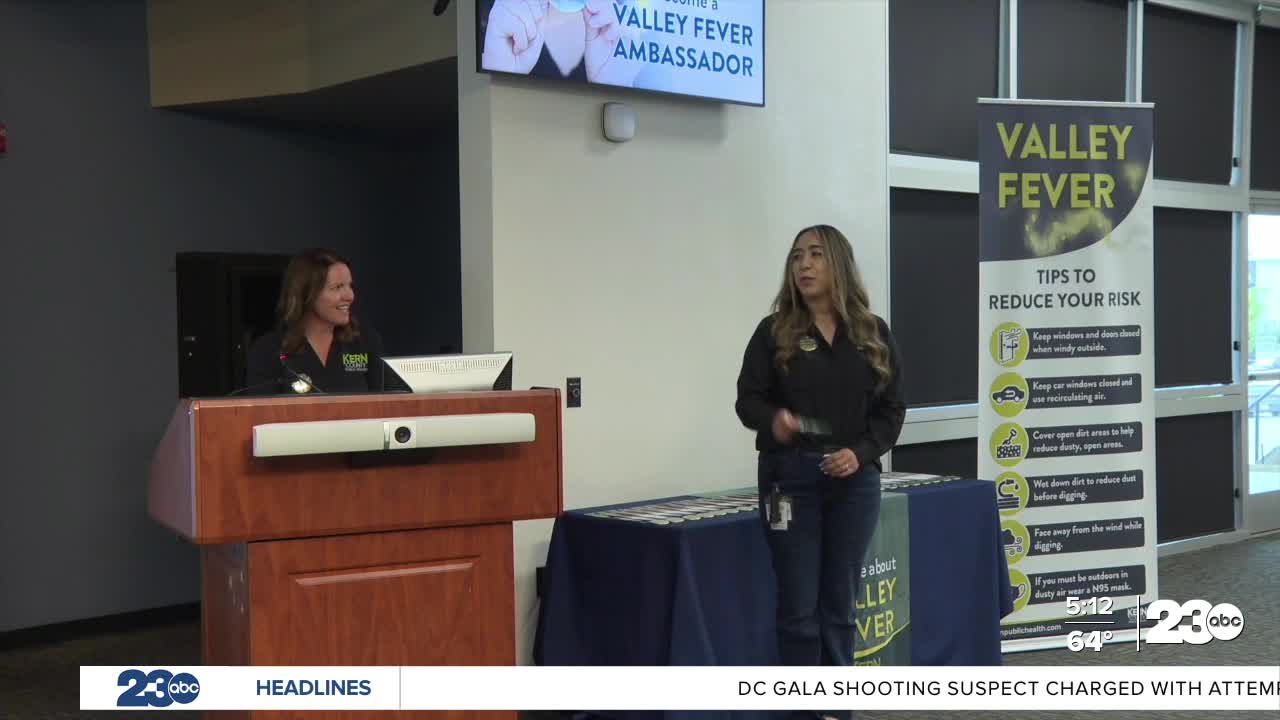


BAKERSFIELD, Calif. (KERO) — Facing a surge in Valley Fever cases, Kern County Public Health Director Brynn Carrigan is launching a new community ambassadors program to raise awareness and boost testing a mission she knows firsthand.
“Today I am proud to announce the launch of our ambassadors program now available to the community,” Carrigan said.
Carrigan’s commitment to the cause is personal. She was diagnosed in 2024 with a severe form of Valley Fever known as pachymeningitis.
“I was shocked to hear that I had pachymeningitis, one of the severest forms of Valley Fever, because I didn’t fit the definition,” she said. “I had no underlying health conditions. I was probably the healthiest version of myself I’ve ever been.”
Now, she’s turning her experience into action. The new campaign, launching May 2, will focus on educating the public through virtual Zoom classes and community outreach.
“The disease is as widespread and impactful as Valley Fever,” Carrigan said. “
The more people we have talking about it, the further our reach will be.”
Health officials say the effort comes at a critical time.
In 2025, Kern County recorded the third-highest number of Valley Fever cases on record more than 3,000 cases and 41 deaths. That’s about 7% above the 10-year average.
Still, the number marks a slight decrease from 2024. Experts say weather patterns may be playing a role.
“As the weather allows the fungus to grow, it’s believed that the large increases are driven by drought conditions,” said epidemiologist Paul Rzucidlo. “Drought can cause other microorganisms in the soil to die off, allowing the Valley Fever fungus to thrive.”
In contrast, recent rainfall and fog may help reduce the spread by limiting how much of the fungus becomes airborne.
At the same time, doctors are working to improve how quickly the disease can be diagnosed.
At Kern Medical, Dr. Carlos D’Assumpcao says researchers including teams at Arizona State University and the Mayo Clinic are developing a rapid, 10-minute blood test similar to a COVID-19 antigen test.
“If we’re able to have that diagnosis right at the beginning, perhaps we don’t have to expose patients to unnecessary antibiotics, and we can start the correct treatment earlier,” D’Assumpcao said.
However, that kind of rapid testing is not yet available locally.
Kern Medical officials say they are still waiting on funding and support from the National Institutes of Health to move forward.
“We actually have a partnership with another company working on rapid diagnostics,” D’Assumpcao said. “We’re waiting on government approval for funding to get that off the ground, and that grant has not yet been answered.”
For now, experts say the key to combating Valley Fever lies in increased awareness, along with more funding and resources to accelerate research especially in regions like the Central Valley, where the disease is most common.
Stay in Touch with Us Anytime, Anywhere: