

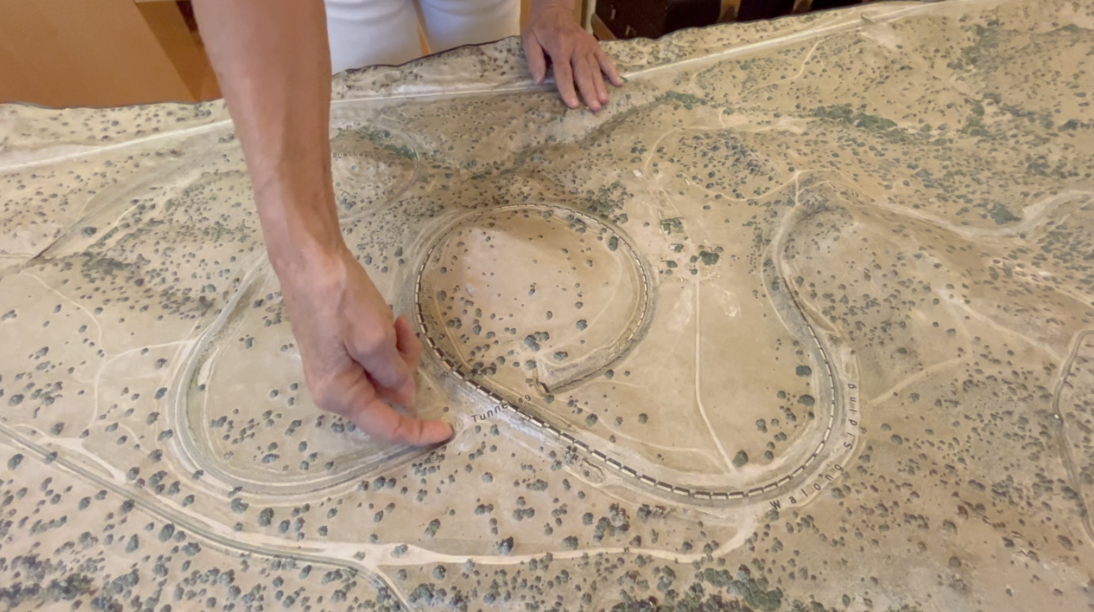


BAKERSFIELD, Calif. (KERO) — The sound of a train horn has echoed through the Tehachapi Pass for a century and a half — and the reason why is one of the greatest railroad engineering feats in American history.
The Tehachapi Loop was completed in 1876 under the direction of Southern Pacific Chief Engineer William Hood as part of the nation's second transcontinental railroad. Building through the mountains presented a significant challenge: engineers needed to find a way to climb thousands of feet without making the grade too steep for trains to handle.
The history of the landmark is kept alive by volunteers at the Tehachapi Depot Railroad Museum. Museum President Diana Buerge described the scale of the engineering challenge.
"From Bakersfield down here at less than 1,000 ft, Tehachapi up here at about 4,000 ft. To get something that heavy up a 3,000-ft grade is amazing," Buerge said.
Volunteer Coordinator Paul Thomas said engineers were uncertain how to navigate the terrain beyond the town of Keene while keeping the train below a critical threshold.
"But once they got past Keene, they weren't really sure what to do with the area, as far as keeping the train below a 2.2% grade," Thomas said.
Buerge said the solution came down to going straight through the mountain.
"The grade is really pretty steep right there, and they said, 'We're just going to go through the tunnel, through the mountain,'" Buerge said.
That's when Hood came up with a design that would become a railroad marvel.
"What if we dug down and we actually made a loop, and have it so the train actually goes underneath itself and then over the top?" Thomas said.
The design allowed trains to gradually gain elevation through the mountains. Today, the Tehachapi Loop is considered one of the seven wonders of the railroad world. More than 150 years later, dozens of trains still pass through each day, and rail fans from across the globe travel to see it. Thomas said its impact on the region can still be felt today.
"Once this came in, this is what built the area up, and now it's one of the busiest rail corridors in the United States," Thomas said.
From helping connect a growing nation to helping build the city of Tehachapi, the Loop remains a lasting symbol of Kern County's place in American history.
This story was reported on-air by a journalist and has been converted to this platform with the assistance of AI. Our editorial team verifies all reporting on all platforms for fairness and accuracy.
Stay in Touch with Us Anytime, Anywhere:
