

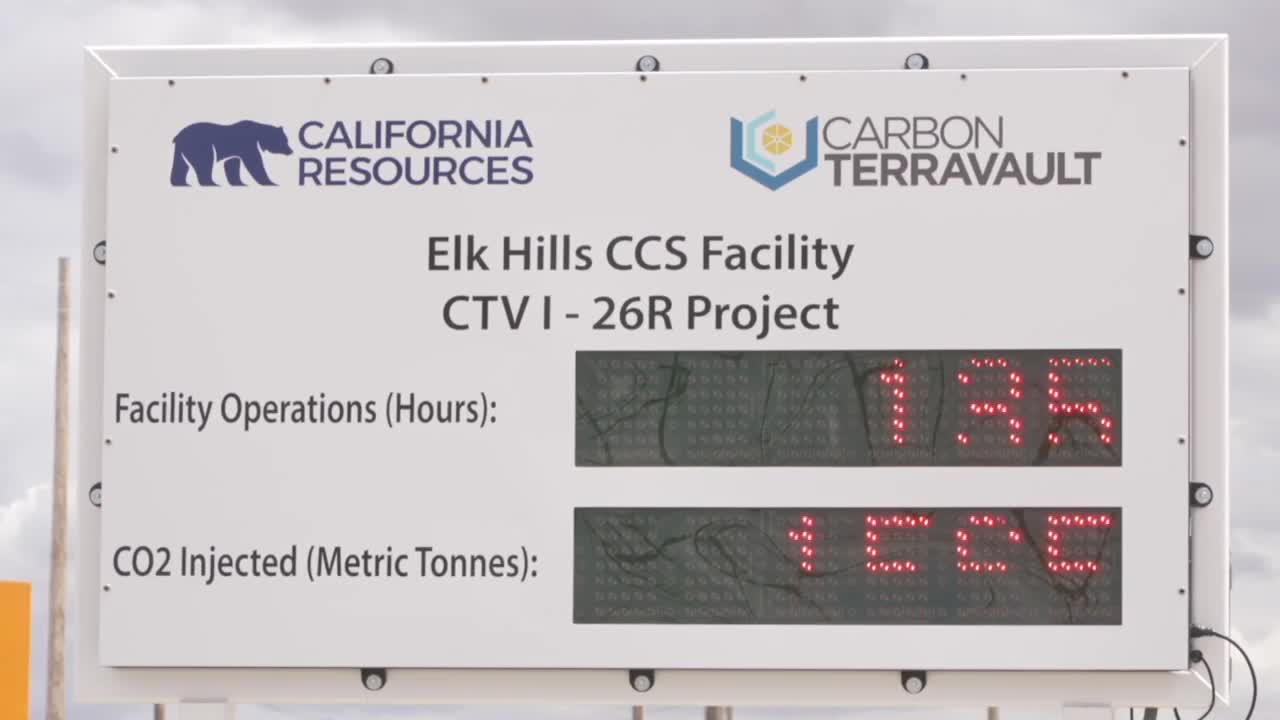



TUPMAN, Calif. (KERO) — California Resources Corporation's first carbon capture and sequestration project is now operational, with the company looking to expand its footprint throughout Kern County.
Carbon capture and sequestration is the method of taking CO2 from local industries like natural gas, oil, and cement production and storing it deep underground in basins.
CRC's Carbon Terravault I has the ability to store approximately 1.5 million metric tons of carbon per year and up to 38 million metric tons overall.
"Being in the early stages of the injection process, we're pleased to report that the facility and the injection are operating perfectly in line with our expectations," said Chris Gould, CRC's Chief Sustainability Officer.
With the project is still in its early stages, Gould said the operation is far from reaching full capacity in what they're able to inject annually.
"The first project, which is the one that we are injecting the CO2 from today, is 100,000 tons per annum, so it's roughly just under 10% of the full capacity of the reservoir," said Gould. "We have our own power plant there on site that could be further decarbonized. We have other field operations that could be decarbonized there as well, and third parties. Carbon Terravault was built as a business that would very specifically work with other companies that have emissions targets that they are trying to comply with, given the state's carbon neutrality goal and their own goals."
Gould added that CRC has identified an additional 350 million tons of storage throughout the Central Valley, which are in various stages of EPA permitting.
The project has not been without opposition. When Carbon Terravault I was going through the environmental review process in 2024, several groups pushed back against it.
Grecia Orozco, a staff attorney for the Center on Race, Poverty and the Environment, based in Delano, was among those who spoke against the project during that process. She said she believes carbon capture amounts to a short-term fix that delays a true transition away from fossil fuels.
"It is incredibly harmful for our community members to be living alongside oil and gas fields, oil and gas refineries, and that these industries will continue operating and continue harming them, because industries like carbon capture will keep them in business instead of the state focusing on other ways to reduce our carbon footprint."
Ileana Navarro, a policy advisor for the Central California Environmental Justice Network, echoed those concerns and called for greater transparency as the project moves forward.
"What CRC is doing to monitor the carbon dioxide that's being pumped underground, if the monitoring is available, if it's publicly available, if that data is in real time, like who's in charge of this data, is it by a third party or is it themselves, you know, reporting this. Yeah, things, things of that nature, just having that monitoring publicly available for residents to see what is being pumped underground so close to them."
The additional projects representing approximately 350 million metric tons of carbon storage capacity are expected to clear EPA hurdles both this year and next.
This story was reported on-air by a journalist and has been converted to this platform with the assistance of AI. Our editorial team verifies all reporting on all platforms for fairness and accuracy.
Stay in Touch with Us Anytime, Anywhere:
